Image
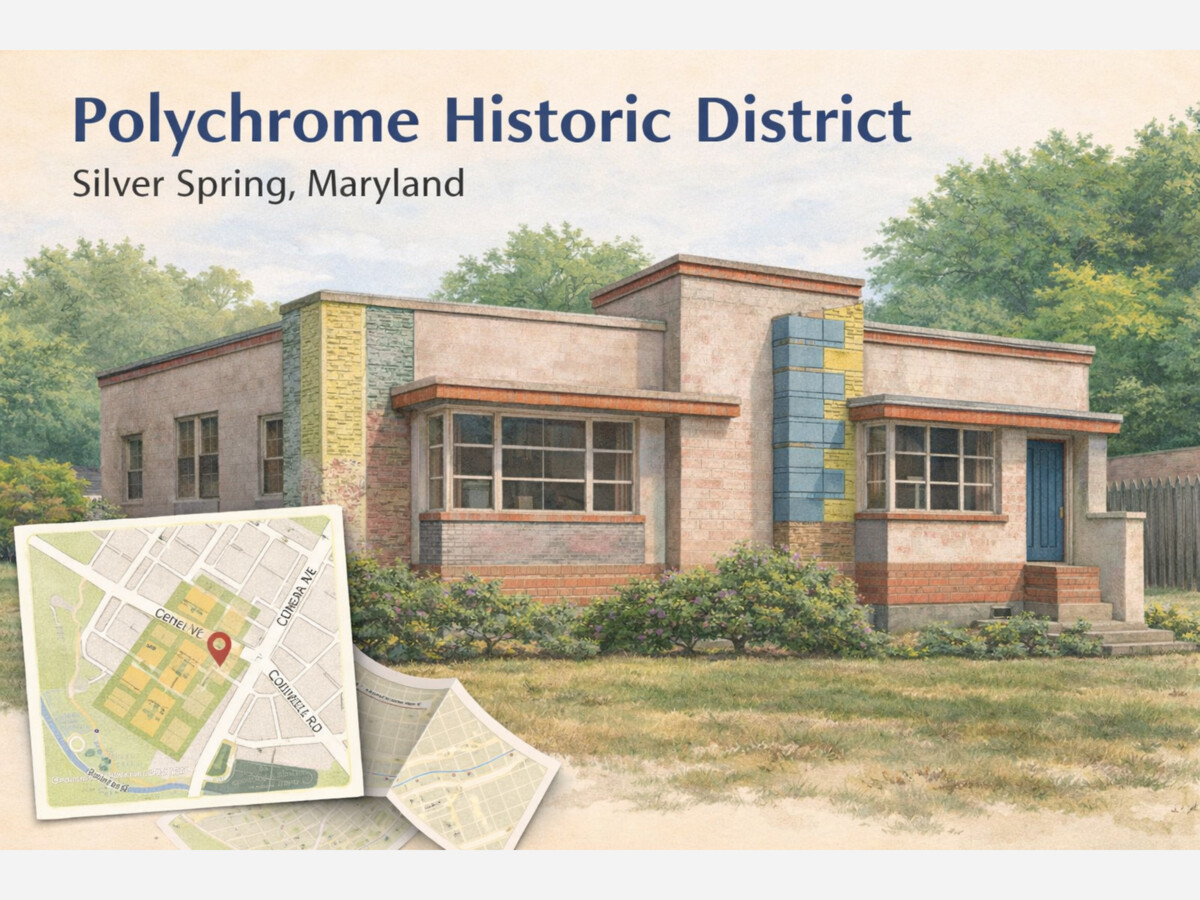



If you’re a regular on Colesville Road, you’ve probably seen them—maybe just out of the corner of your eye as you merge toward the Beltway. Right there at the edge of Four Corners, tucked away at 9904 Colesville, sits a small, vibrant cluster of homes that feel less like suburban Maryland and more like something out of a classic Hollywood backlot.
These are the Polychrome Houses—one of Silver Spring’s best-kept secrets.
Built in 1934 by John Joseph Earley, these five homes were a bold experiment. Earley believed the “house of the future” didn’t have to be gray or predictable. Using pre-cast concrete panels infused with colorful crushed quartz and ceramics, he created what he called “architectural concrete”—surfaces that shimmered with color and light. While much of the country was in the depths of the Great Depression, Earley was right here proving that middle-class housing could be both durable and beautifully designed.
They’re essentially Art Deco gems—meant to be affordable, repeatable, and lasting.
But “lasting” is a complicated idea in a growing region. With the arrival of the Purple Line and the steady evolution of the Four Corners area, the landscape is shifting. This isn’t about resisting change—it’s about recognizing what’s already here, and making sure these landmarks aren’t overlooked in the process.
The Polychrome Houses are a reminder that Silver Spring has always been a place for bold ideas and experimentation. As construction hums and the neighborhood continues to grow, take a moment to notice these colorful walls—and the vision behind them.
Before the skyline shifts too far, it’s worth holding onto the stories of the people who’ve kept these bright, enduring designs alive for nearly a century. Because a neighborhood is more than a pass-through—it’s a collection of details, histories, and quiet wonders hiding in plain sight.



Sunny, with a high of 69 and low of 48 degrees. Sunny for the morning, clear during the afternoon and evening,